CANbus Troubleshooting Toolkit
Diagnostics

ⓘ Please contact us for partner and OEM pricing here.


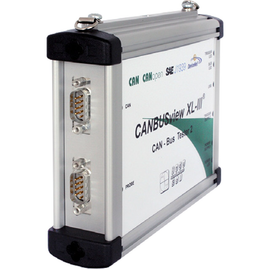
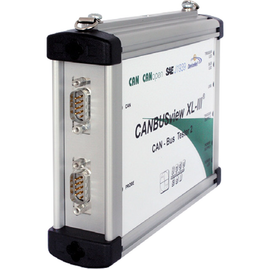
Universal CAN measuring tool: Quality tester CANBUSview XL III
The CANBUSview XL is a universal measuring instrument for commissioning, analysis, monitoring, troubleshooting and maintenance of CAN based fieldbus protocols for example CAN/CANopen, DeviceNet, SafetyBUS p and SAE J1939.
Quality value determination
By means of the especially developed measurement method the signal ratio is rated qualitatively and shown device-related in a bar chart. The quality value (Q value) represents the most essential physical attributes of the bus and displays them as a bar height from 0 to 100%. The essential factors for quality value determination are edge steepness, signal-to-noise ratio and reflections. All three components contribute equally to the calculation of the quality level.
Oscilloscope display with telegram analysis
For evaluation of signal transitions and also for measuring reflection points the CANBUSview XL shows the signal shape of the measured telegram and shows it in an oscilloscope display of the user software. The scanning works with 64 times the adjusted baud rate over 160 bit in total.
CANBUSview XL III Features
- Physical analysis with bar diagram
- Line test (offline)
- Oscilloscope feature
- Logical monitoring of the protocols
- Long-term analysis
- Report retrieval
- All CAN protocols in one device (CAN, CANopen, SafetyBUS p, DeviceNet, SAE J1939)
Function
The CANBUSview XL is a tool for determining the physical and logic communication quality of the data exchange in CAN networks. The measurement is performed online while the system is running. By means of
an adapter the hardware is plugged feedback-free onto the CAN. The measuring and test results are displayed through a software on your PC. A standardized USB interface is used for the connection to the PC.
We recommend to use the two ends of each segment/master system as measuring location in the CAN network. For this purpose suitable measuring points have to be provided.
The Measuring Principle
CAN protocols
With the CANBUSview XL various CAN protocols can be analyzed and evaluated in terms of quality, such as CAN, CANopen, SafetyBUS p and DeviceNet. Prior to the measurement the user is requested to select the relevant CAN protocol.
Physical quality determination
Signal quality
The CAN bus works with a differential voltage signal transmitting the logic telegram content to the lines CAN-H and CAN-L. The amount of the voltage differential and the form of these signals are a measure of the physical transmission quality and signal quality. Every bit undergoes a 64-fold scan. Major parameters used for the analysis are edge steepness, signal-to-noise voltage ratio and ripple of the CAN signal.
The measuring result is recorded over the time and as Q-value in the form of a bar chart. This measuring technique allows an easy and quick determination of the actual quality of the data communication.
Wiring test
To ensure a correct bus wiring, the CANBUSview XL has an integrated wiring test. Any line short-circuits, line break, missing or additional terminating resistor can be detected and eliminated. In addition the loop resistances of the CAN line and the CAN current supply line and the total line length are determined.
Logic quality determination
Parallel to the physical transfer quality determination the CANBUSview XL checks the telegram traffic for defective telegrams, missing acknowledgements and overload of bus devices as well as the general bus capacity utilization. The online trigger is used to analyze the communication quality over several days / weeks. This helps to detect sporadic communication faults and allocate the same to a certain period of time. The online trigger is capable of analyzing physical and logical faults.
CANbus Troubleshooting Toolkit includes:
- CANbus View XL
- Power Supply with variants for Europe, Great Britain, U.S.A./Japan, (Australia possible)
- For connection to a Digital Storage Oscilloscope: Probe Adapter and BNC Trigger cable
- Adapter set 1: D-Sub 9 • Adapter cable 1 • Shorting plug 1 • Terminating resistor
- Adapter set 2: Open style • Adapter cable 2 • Shorting plug 2 • Adapter for Open style
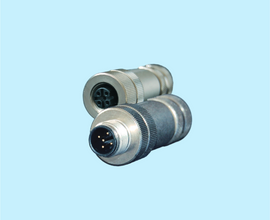
- Adapter set 3: M12 • Adapter cable 3 • Shorting plug 3 • Terminating resistor • T-piece
- Adapter set 4: 7/8“ • Adapter cable 4 • Shorting plug 4 • Terminating resistor • T-piece
- Adapter set 5: SAE J1939-11 • Adapter cable 5 • Shorting plug 5 • Terminating resistor • Y-piece
- Adapter set 6: SAE J1939-13 • Adapter cable 6
Adapters